The printing and packaging industry in Oman is entering an important new phase in 2026. Businesses are paying more attention to how their products look, how their brands are presented, and how customers experience them.
Today, printing and packaging is no longer simply about producing a brochure or manufacturing a box. It has become an important part of branding, marketing, product presentation, sustainability, and customer experience.
From commercial printing and food packaging to luxury rigid boxes, folding cartons, paper bags, labels, and promotional materials, demand is shifting toward solutions that are more creative, customized, efficient, and environmentally responsible.
For Oman, this evolution presents significant opportunities for businesses, suppliers, designers, manufacturers, and young professionals entering the industry.
Printing and Packaging in Oman Is Evolving
Oman’s business environment continues to diversify, creating new requirements for professional printing and packaging.
Hotels, restaurants, perfume brands, food manufacturers, retailers, corporate organizations, SMEs, and locally developed brands all depend on printed and packaged products in different ways.
At the same time, expectations are changing.
Customers increasingly expect better design, accurate colours, quality materials, attractive finishing, faster delivery, and more customization. This means printing and packaging companies in Oman need to offer more than production capacity—they need technical knowledge, creativity, and the ability to recommend the right solution.
Packaging Is Becoming Part of the Brand
A box is no longer just a box.
The first thing a customer may notice about a perfume, chocolate, dates, cosmetics, or premium gift is its packaging.
Before experiencing the actual product, customers experience the printing and packaging surrounding it.
This makes packaging an important branding tool.
A well-designed rigid box can communicate luxury. A beautifully printed folding carton can make a retail product more noticeable. A premium paper bag can continue advertising a brand long after the customer leaves the store.
In 2026 and beyond, businesses in Oman are likely to place even greater importance on packaging that reflects the quality and personality of their brands.
The Growth of Luxury Printing and Packaging
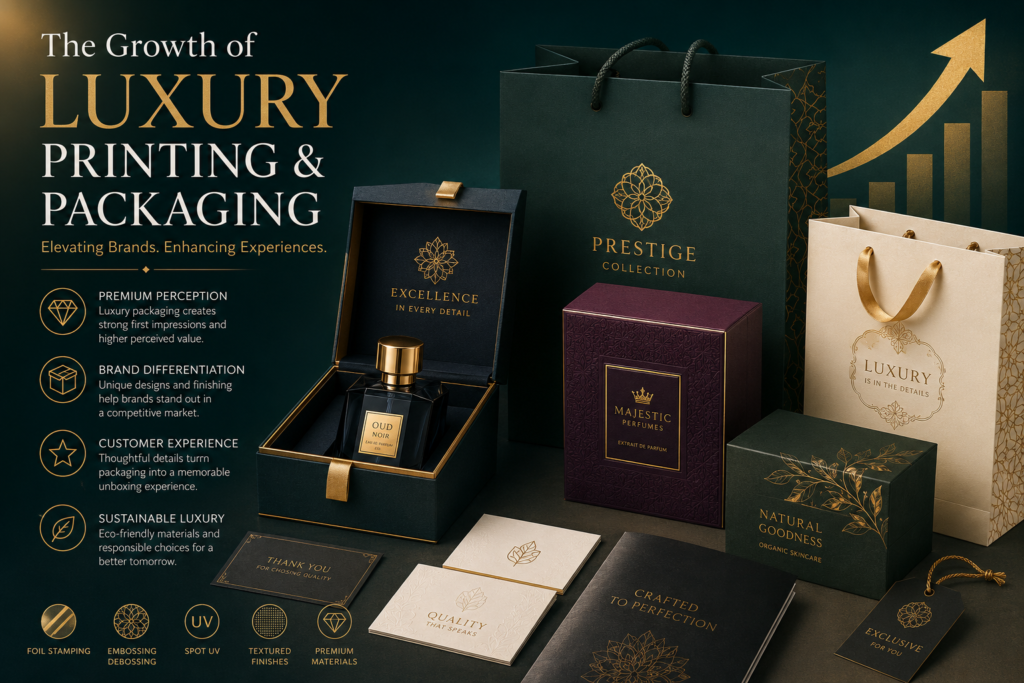
Oman has a strong market for products where presentation matters.
Perfumes, frankincense, dates, chocolates, jewellery, hospitality products, corporate gifts, and premium food products are all categories where luxury printing and packaging can add significant perceived value.
Rigid boxes, magnetic boxes, premium folding cartons, luxury paper bags, customized sleeves, and specialty inserts provide brands with opportunities to create memorable product experiences.
Finishing techniques such as foil stamping, embossing, debossing, spot UV, textured papers, specialty boards, and premium laminations can further enhance the presentation.
For premium products, customers are not simply opening a package—they are experiencing the brand.
Commercial Printing Still Matters in 2026
The growth of digital marketing does not mean that commercial printing has disappeared.
Brochures, catalogues, business cards, annual reports, folders, menus, notebooks, calendars, stationery, leaflets, and promotional materials continue to have a place in business communication.
What has changed is the expectation of quality.
Businesses may be more selective about what they print, but when they do print, they increasingly want the material to look professional and represent their brand properly.
The future of commercial printing may therefore be less about printing more and more about printing better.
Offset and Digital Printing Will Work Together
There is often a discussion about whether digital printing will eventually replace offset printing. In reality, both technologies have important roles.
Offset printing continues to offer excellent quality and cost efficiency for many medium- and high-volume printing and packaging requirements.
Digital printing, meanwhile, provides flexibility for shorter quantities, faster production, variable data, prototypes, and customized applications.
In 2026, the smartest approach is not necessarily choosing one technology over another. It is understanding the customer’s requirements and selecting the most appropriate production method for the job.
The customer ultimately wants the right quality, quantity, price, and delivery time.
Customized Printing and Packaging Will Grow
Customization is becoming increasingly important.
Businesses want their packaging to be recognizable rather than looking like a standard box with a logo added to it.
This creates demand for customized dimensions, structural designs, materials, colours, inserts, finishes, and printing techniques.
Shorter production runs also allow companies to experiment with special-edition printing and packaging for Ramadan, Eid, Oman National Day, corporate events, weddings, product launches, and seasonal promotions.
This flexibility can be particularly valuable for SMEs and emerging Omani brands that may not initially require very large quantities.
Structural Packaging Design Will Become More Important
Great packaging begins before anything goes to print.
The dieline, dimensions, material thickness, folding method, opening mechanism, inserts, and overall construction can determine whether packaging performs successfully.
In the future, printing and packaging suppliers will increasingly need to provide technical support during the development stage.
Sometimes changing the structure of a box can reduce material consumption. A different board can improve strength. A redesigned insert can protect the product more effectively.
Good packaging design should consider appearance, protection, functionality, production efficiency, and cost at the same time.
Sustainability in Printing and Packaging
Sustainability is becoming increasingly important across the global printing and packaging industry, and Oman is part of this transition.
Businesses are becoming more conscious of unnecessary materials and packaging waste.
This creates opportunities for recyclable paper and board, responsibly sourced materials, reduced plastic content, efficient packaging structures, and designs that use fewer unnecessary components.
However, sustainable packaging does not have to look inexpensive.
Creative structural design, attractive papers, intelligent use of typography, and carefully selected finishes can produce packaging that feels both premium and responsible.
The future will increasingly be about finding the right balance between sustainability, functionality, appearance, and cost.
Reducing Waste Through Smarter Production
Sustainability is not limited to the final package.
The printing and packaging production process itself can become more efficient.
Better production planning, optimized sheet layouts, improved colour control, efficient machinery, responsible waste management, and accurate quantity planning can help reduce unnecessary paper, board, ink, energy, and production time.
Sometimes the most sustainable solution is simply avoiding unnecessary production.
Technology and automation can help printing and packaging companies achieve greater efficiency while maintaining consistent quality.
Food Packaging Will Be an Important Market
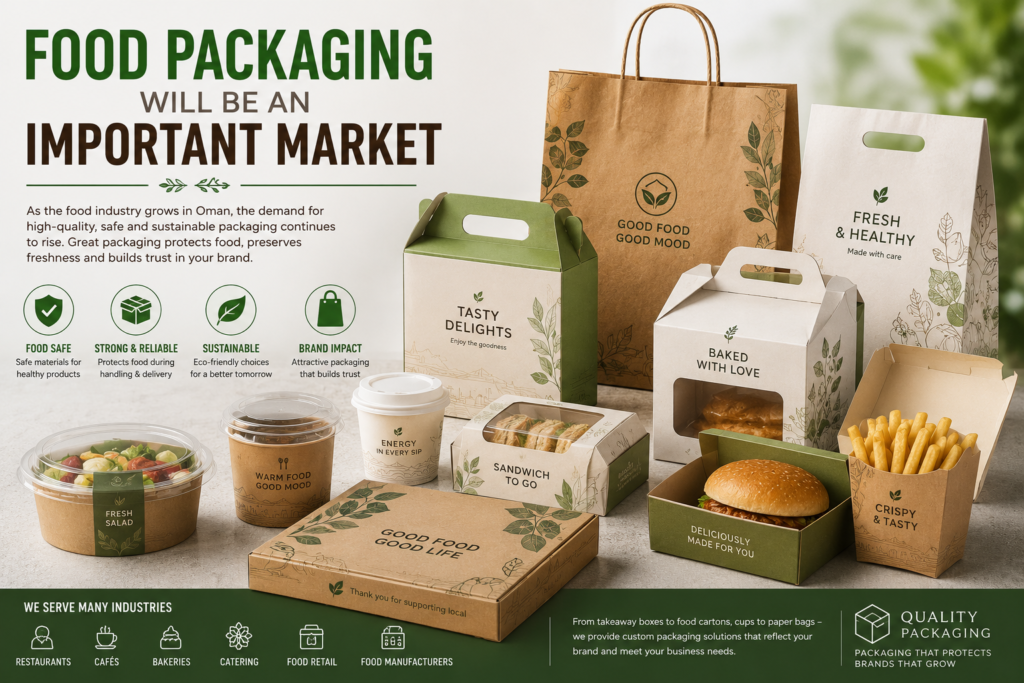
Food and beverage businesses represent an important opportunity for printing and packaging in Oman.
Restaurants, bakeries, cafés, chocolate brands, date producers, confectionery companies, catering businesses, and food manufacturers all require packaging.
Food packaging must do several jobs simultaneously. It should protect the product, be suitable for its intended use, communicate the brand, and provide an attractive presentation.
As locally produced food brands continue developing, demand for customized food-grade boxes, folding cartons, sleeves, labels, takeaway packaging, and paper bags should remain an important part of the market.
Printing and Packaging for Oman’s Hospitality Sector
Oman’s hospitality and tourism industries also create opportunities for printing businesses.
Hotels and resorts require menus, notepads, folders, envelopes, room stationery, key-card holders, promotional materials, food packaging, gift boxes, and branded bags.
For premium hospitality brands, consistency matters.
A guest should experience the same brand quality across the hotel’s signage, stationery, menus, packaging, and promotional materials.
Professional printing and packaging therefore becomes part of the overall guest experience.
Technology and Automation Are Changing the Industry
Technology is transforming almost every stage of printing and packaging production.
Modern offset presses, digital printing systems, automated die-cutting, computer-controlled cutting equipment, colour-management systems, digital finishing, and advanced design software can improve accuracy and productivity.
Automation can also help reduce production time and minimize errors.
But technology alone cannot guarantee a successful product.
Experience is still required to choose the appropriate material, understand production limitations, identify potential problems, and recommend the correct printing and finishing process.
The future of printing and packaging will combine technology with human expertise.
Artificial Intelligence Will Support Printing and Packaging Design
Artificial intelligence is also beginning to influence creative industries.
AI-assisted tools can support concept development, visualization, artwork preparation, image creation, and marketing ideas. They can help designers and customers explore packaging concepts much faster than before.
However, converting a visual concept into a box that can actually be manufactured still requires technical knowledge.
Material thickness, dielines, folds, glue areas, printing tolerances, colour reproduction, finishing, and production methods all have to be considered.
AI can therefore become a useful tool, but practical printing and packaging expertise will remain essential.
Career Opportunities in Printing and Packaging in Oman
The changing industry also creates interesting career opportunities.
Modern printing and packaging combines creativity, engineering, technology, manufacturing, marketing, and customer service.
Career opportunities can include graphic designers, packaging designers, prepress specialists, printing technicians, offset and digital press operators, finishing specialists, production planners, quality-control professionals, estimators, procurement specialists, technical sales professionals, and production managers.
Sustainability may also create new areas of specialization involving materials, packaging optimization, recycling, and environmentally responsible product development.
Opportunities for Young Omani Professionals
As Oman continues developing local manufacturing capabilities and technical skills, the printing and packaging sector can offer opportunities for young Omani professionals.
There is room to build expertise in areas such as:
- Graphic and packaging design
- Packaging engineering and dieline development
- Digital and offset printing technology
- Colour management and prepress
- Production management
- Sustainable packaging
- Quality control
- Technical sales and customer support
- Automation and digital workflows
- Marketing and brand development
These roles require different combinations of creativity and technical knowledge, making printing and packaging a surprisingly diverse industry.
Supporting Made-in-Oman Products
One of the most exciting opportunities is the growth of locally developed and manufactured products.
An Omani perfume, box of dates, chocolate collection, food product, or corporate gift may compete with products from established international brands.
Quality printing and packaging can help level that playing field.
Professional packaging gives local products stronger shelf presence and can help communicate quality, authenticity, and value.
As more products are developed and manufactured within Oman, local printing and packaging expertise can become part of the wider ecosystem supporting Omani businesses.
Technical Knowledge Will Remain Valuable
Customers should not have to understand every technical aspect of printing.
A good printing and packaging company should be able to listen to the customer’s requirements and recommend suitable materials, printing methods, structures, and finishes.
Should the box use folding box board or rigid board? Should the design be offset or digitally printed? Does it require lamination? Would embossing or foil improve the presentation? Can the structure be simplified?
Providing these answers is where experience becomes valuable.
The future of the industry is therefore not simply about selling printing. It is about providing printing and packaging solutions.
Building Long-Term Printing and Packaging Partnerships
Another change we expect to see is businesses looking for reliable long-term suppliers rather than purchasing every project purely on price.
A supplier who understands a customer’s brand, colours, materials, previous projects, quality expectations, and delivery requirements can provide greater consistency over time.
That relationship can gradually develop from supplier and customer into a genuine business partnership.
At Quality Packaging, this is an important part of how we see the future.
Looking Ahead: Printing and Packaging in Oman Beyond 2026
The future of printing and packaging in Oman looks promising, but it will also require the industry to keep evolving.
Customers will expect better quality, faster production, greater customization, sustainable options, innovative packaging structures, and knowledgeable technical support.
Technology will continue to change how we design and manufacture products. Automation will improve efficiency. Sustainability will influence materials and construction. Digital printing will expand customization possibilities, while offset printing will continue to serve demanding commercial and packaging applications.
But behind all these developments, one principle remains simple:
Good printing and packaging should make a product look better, communicate its value, and help the brand behind it stand out.
At Quality Packaging, we look forward to contributing to the next chapter of printing and packaging in Oman—combining experience, creativity, materials, technology, and service to create solutions that make a lasting impression.
Frequently Asked Questions About Printing and Packaging in Oman
1. What is the future of printing and packaging in Oman?
The future of printing and packaging in Oman is moving towards greater customization, better print quality, sustainable materials, smarter production methods and more creative packaging designs. As local businesses and Omani brands continue to develop, professional printing and packaging will become increasingly important for product presentation and brand identity.
2. Is the printing industry still growing despite digital marketing?
Yes. Digital marketing has changed how businesses communicate, but it has not removed the need for printing. Brochures, catalogues, business cards, menus, stationery, labels, promotional materials and packaging continue to be important. The industry is shifting towards higher-quality, more targeted and more purposeful printing.
3. Why is packaging important for a brand?
Packaging is often the first physical interaction a customer has with a product. Good packaging can communicate quality, build brand recognition and improve the perceived value of the product. This is particularly important for perfumes, chocolates, dates, cosmetics, food products, gifts and other premium products.
4. What printing and packaging products are commonly required by businesses in Oman?
Businesses require a wide variety of printing and packaging products, including brochures, booklets, leaflets, business cards, stationery, folders, catalogues, labels, folding cartons, corrugated boxes, rigid boxes, food-grade boxes, luxury paper bags, calendars and promotional materials.
The exact solution depends on the business, product, quantity, budget and required presentation.
5. What is the difference between offset printing and digital printing?
Offset printing is generally well suited to medium and large quantities where consistent colour, excellent quality and cost efficiency are important.
Digital printing offers greater flexibility for shorter quantities, faster production and personalized or variable designs.
A professional printing and packaging company should recommend the most suitable process based on the requirements of each project rather than applying the same production method to every job.
6. What is sustainable printing and packaging?
Sustainable printing and packaging focuses on reducing unnecessary waste and making more responsible choices regarding materials and production.
This can include recyclable paper and board, responsibly sourced materials, optimized packaging dimensions, reduced plastic components and efficient production planning.
Sustainability is not only about the material used. Good design can also reduce waste by creating packaging that uses fewer unnecessary components while still protecting and presenting the product effectively.
7. Can sustainable packaging still look luxurious?
Absolutely. Sustainable packaging does not necessarily have to look basic.
Creative structural design, premium paper, embossing, carefully selected colours and intelligent use of finishing techniques can create packaging that feels sophisticated while avoiding unnecessary materials.
The future of luxury printing and packaging is likely to focus increasingly on achieving maximum visual impact through smarter material choices and thoughtful design.
8. Why are rigid boxes becoming popular?
Rigid boxes provide strength, premium appearance and an excellent unboxing experience. They are particularly suitable for perfumes, chocolates, jewellery, corporate gifts, dates and other high-value products.
They can also be customized with inserts, specialty papers, foil stamping, embossing and other premium finishes, making them an important part of the luxury packaging market.
9. How can printing and packaging help Omani products compete in the market?
Good printing and packaging can help locally produced products achieve a professional appearance comparable with established international brands.
Strong branding, accurate printing, quality materials and attractive packaging can improve shelf presence and communicate the value of an Omani product before the customer even opens it.
This can be particularly valuable for locally produced perfumes, dates, chocolates, food products, gifts and other Made-in-Oman products.
10. How will technology change printing and packaging?
Technology will continue to improve automation, colour accuracy, production speed and customization.
Modern offset presses, digital printing equipment, automated cutting and die-cutting systems, colour-management software and digital finishing technologies are making printing and packaging production increasingly efficient.
Artificial intelligence may also support concept creation and design visualization, while skilled professionals will still be required to turn those concepts into technically correct, manufacturable products.
11. Are there career opportunities in printing and packaging in Oman?
Yes. Modern printing and packaging offers careers across creative, technical and commercial fields.
Opportunities include graphic design, packaging design, dieline development, prepress, offset printing, digital printing, machine operation, production planning, quality control, procurement, estimating, technical sales, customer service and production management.
As sustainability and automation become more important, new skills related to sustainable materials, digital workflows and packaging technology will also become increasingly valuable.
12. How do I choose the right printing and packaging supplier in Oman?
Look beyond price alone.
A good printing and packaging supplier in Oman should understand materials, printing methods, colour, structural design and finishing. They should also be able to recommend practical solutions based on your product, quantity, budget and desired appearance.
Consistent quality, communication, technical knowledge and dependable service are especially important when choosing a long-term printing and packaging partner.
Have a Printing and Packaging Project in Mind?
Every project is different. Whether you require commercial printing, a folding carton, corrugated box, luxury rigid box, food packaging, customized paper bag or branded promotional material, choosing the right combination of design, material, printing and finishing can make a significant difference.
At Quality Packaging, our approach is to understand the requirement first and then help identify a practical solution that balances quality, presentation, functionality and cost.
As the industry continues to evolve in 2026 and beyond, we believe the future of printing and packaging in Oman will belong to businesses that combine creativity, technical knowledge, sustainable thinking and a genuine understanding of their customers.